Abrasive discs wear down faster than expected in most industrial workshops, and the cause is usually attributed to operator pressure. Force does accelerate mechanical wear, but it is rarely the only factor.
An abrasive disc depends on a balance between surface speed and material removal. When that balance is disturbed, the bonding resin breaks down early or the abrasive grains fracture before they cut. Four mechanical and electrical factors commonly explain the problem.
1. Spindle Speed Drop Under Heavy Load
Abrasive discs are designed to run within a specific surface speed range, typically around 80 m/s for standard 125mm and 230mm sizes.
When a conventional brushed motor meets heavy resistance, it slows down. Below the design speed, the abrasive grains stop shearing chips from the steel and begin dragging across the surface instead. Friction and heat rise, the resin bond softens, and usable abrasive sheds without removing more material.
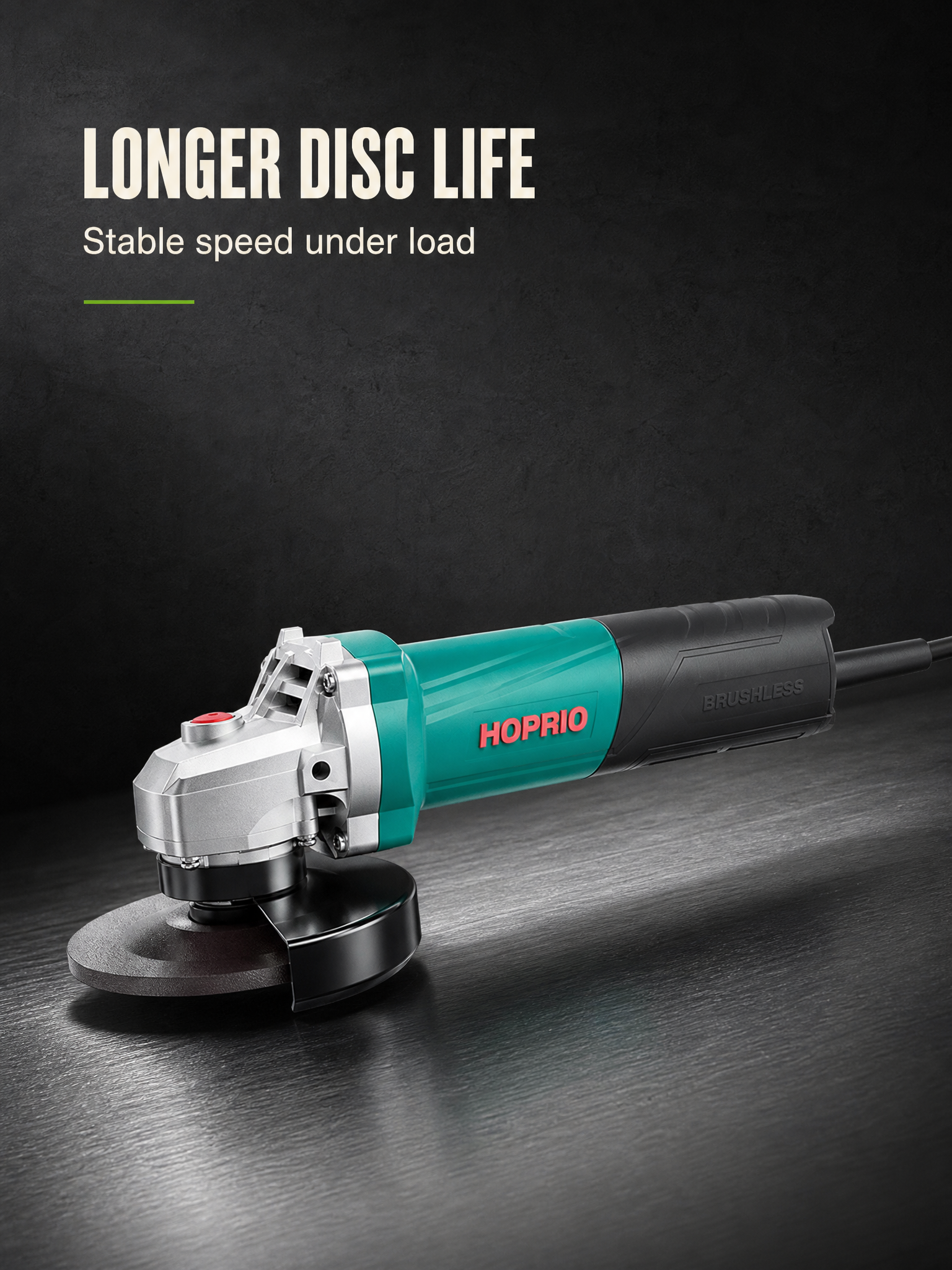
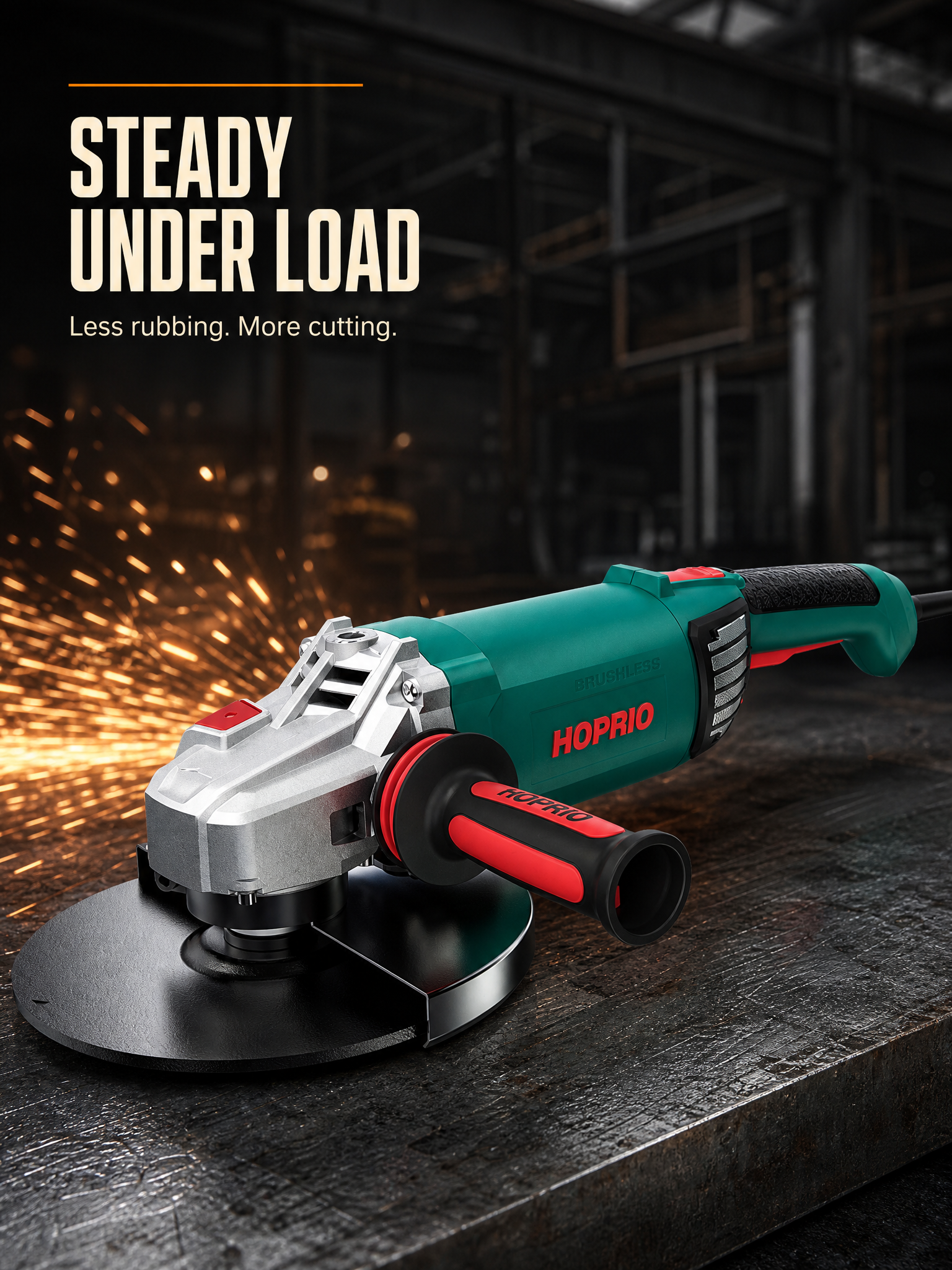
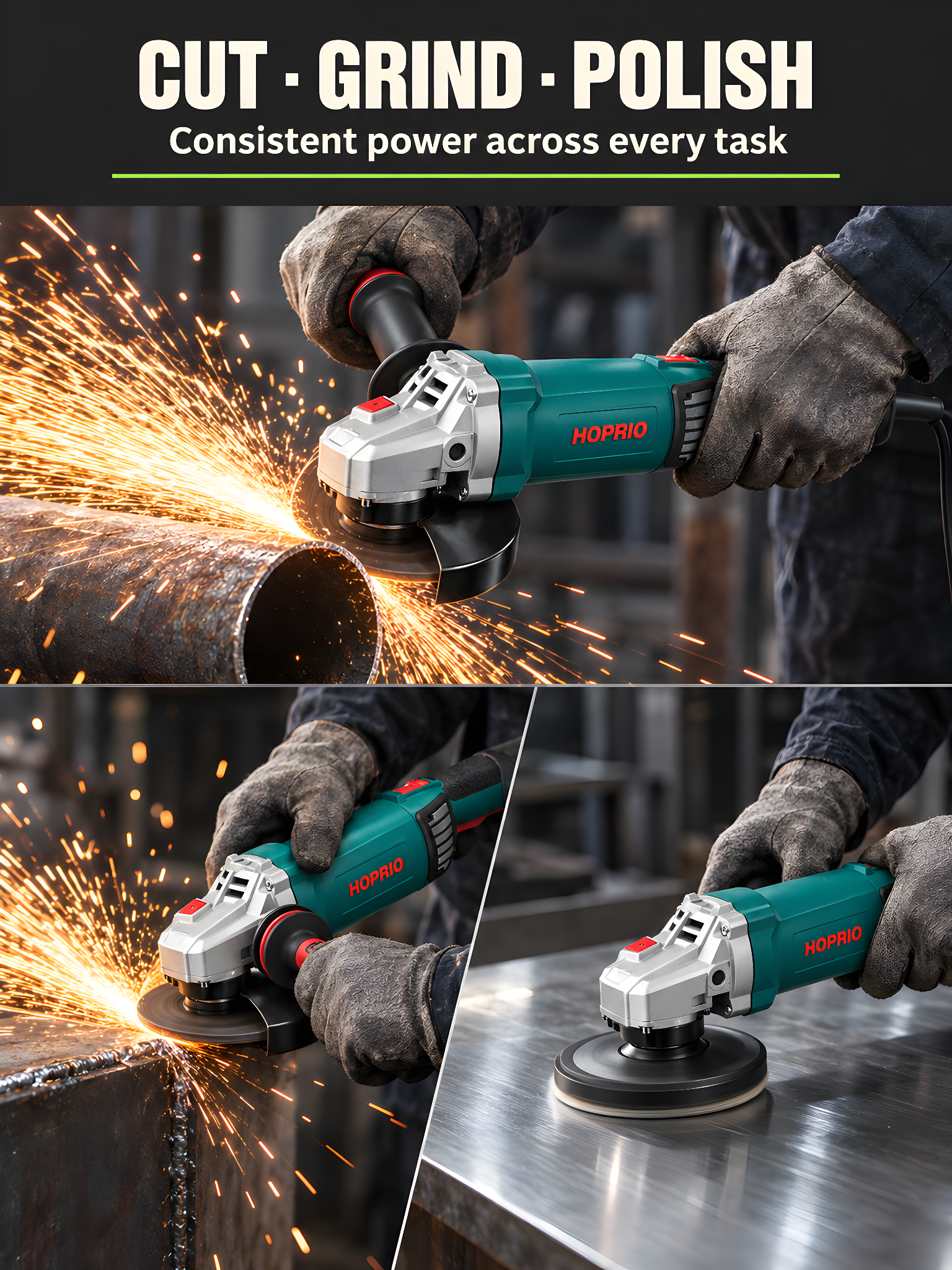
This is what constant-speed-under-load control addresses. In HOPRIO's angle grinder platforms, the controller adjusts power output automatically to hold spindle speed and torque steady across cutting, grinding, and polishing tasks, so the disc continues to cut rather than rub.
2. Spindle Runout and Mechanical Vibration
A disc spinning at 8,000 to 10,000 RPM is sensitive to rotational instability. If the spindle runs out of true, the disc strikes the workpiece unevenly on every revolution.
The result is micro-impact rather than smooth abrasion. Clusters of abrasive grain fracture off mechanically instead of wearing down gradually — wasted abrasive, uneven surface finish, and more vibration transmitted to the operator.
Runout is controlled at the manufacturing stage through gearbox and spindle tolerances. HOPRIO's angle grinder housings also incorporate an anti-impact system that detects accidental drops and triggers internal safeguards, reducing the impact damage that would otherwise disturb spindle alignment.
3. Excessive Operating Temperature
Grinding concentrates heat at the contact point. Under continuous duty, that heat accumulates in the disc body and the front gear housing.
Organic resin bonds weaken under prolonged high temperature. As the bond softens, grains release under normal grinding pressure. Tools with restricted cooling airflow keep the cut zone hotter, which accelerates the cycle.
Two HOPRIO design decisions bear on this. The first is overheat protection: internal monitoring cuts drive output when temperature reaches safe limits, before damage occurs. The second is capacitor-free construction — removing electrolytic capacitors eliminates a component that degrades with heat and is a known weak point in conventional tools.
4. Power Fluctuations and Inconsistent Torque
On long extension leads or generator-supplied sites, voltage drops whenever heavy equipment cycles on. A universal motor loses torque and speed immediately, producing the inefficient rubbing condition described above.
HOPRIO's controllers provide balanced power output, maintaining stable performance through voltage swings and heavy loads rather than letting output track the supply.
What HOPRIO Builds Differently
HOPRIO designs and manufactures brushless motors and their controllers in-house. The controller range sold as standalone products — including no-Hall sensor IGBT controllers such as the HP-DB2207 with a 3,000–30,000 rpm speed range — is the same technology family used inside the HOPRIO's finished tools.
Because motor and controller are developed together, protection thresholds and speed regulation are tuned to each specific tool platform rather than inherited from general supplier defaults.
For distributors and tool brands, OEM/ODM orders are supported with custom speed profiles, housing color, and private labeling from 300 units.
Conclusion
Excessive disc wear is largely a consequence of fluctuating spindle speed and mechanical instability rather than operator error alone. Holding rotational speed steady under load, maintaining spindle alignment, and controlling operating temperature allow abrasive consumables to reach their designed service life. For high-volume metalworking facilities, equipment with active electronic speed stabilization reduces annual consumable expenditure.