In shipbuilding, every weld seam, every square meter of hull plate, and every fitting-out task demands grinding, cutting, deburring, and surface preparation. Angle grinders are among the most heavily used tools in a shipyard. For decades, brushed angle grinders were the default choice. But that is changing. Shipyards worldwide—from China to Southeast Asia—are increasingly replacing them with brushless alternatives. The reason is not a trend. It is a matter of cost, productivity, and safety.
The Hidden Cost of Carbon Brushes
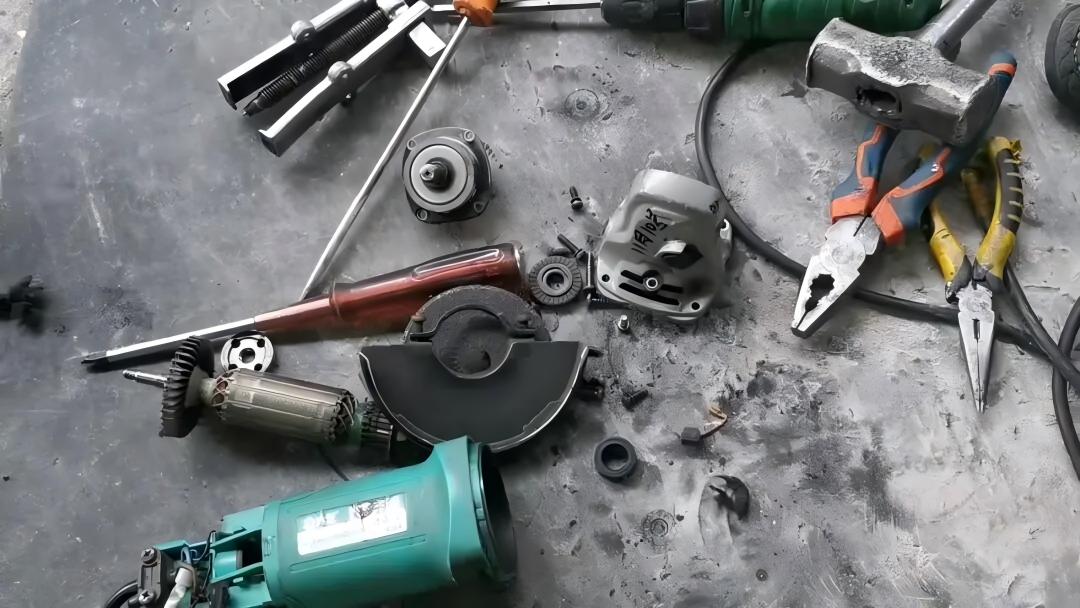
A brushed angle grinder relies on carbon brushes to transmit current to the motor's rotor. The brushes press against the commutator (copper head) as the motor spins. Friction wears them down. A typical set of carbon brushes lasts anywhere from 100 to 300 working hours before needing replacement. In a shipyard where grinders run for hours daily, that means replacing brushes every few weeks or even days on heavily used tools.
The problem does not stop at brush replacement. When brushes wear too short, contact pressure drops. Sparking increases. You can smell ionized air. If left unchecked, the commutator gets scorched and pitted. At that point, replacing brushes alone no longer helps—the rotor itself must be replaced or reconditioned. The useful life of a brushed motor is often limited to one or two brush changes before the commutator is damaged beyond repair. In shipyard conditions—dust, vibration, moisture, continuous heavy loads—that failure cycle accelerates.
Beyond maintenance downtime, brushed motors lose efficiency under load. Apply pressure to a grinding disc, and the RPM drops significantly. Slower speed means slower material removal. Longer job time. More operator fatigue. Higher labor cost per ton of steel processed.
What Brushless Changes
A brushless motor eliminates carbon brushes and the commutator entirely. Commutation is controlled electronically. There is no physical friction between moving electrical contacts. The result is a motor that simply does not have the wear parts that fail in brushed designs.
The practical benefits in a shipyard are measurable:
Longer service life. Brushless motors typically last 5 to 6 times longer than brushed motors—some estimates range up to 10 times longer. A grinder that stays on the job instead of the repair bench directly reduces tool replacement and maintenance costs.
Higher efficiency. With no brush friction and no spark energy loss, brushless motors convert more electrical power into mechanical work. Efficiency gains of 30% or more are common. Some brushless grinders deliver power equivalent to a 1500W brushed machine while drawing less current. Lower energy consumption per ton of ground steel adds up across a fleet of tools.
Constant speed under load. This is perhaps the most critical advantage for shipyard work. A brushless grinder maintains its rated RPM even when you lean into a heavy weld seam. Faster material removal means fewer man-hours per job. Abrasive discs also last longer because they operate at their optimal speed instead of slowing down and glazing over.
Reduced spark hazard. Shipyards are not exactly low-risk environments. Fuel, paint fumes, and other combustibles are often present. Brushed motors generate sparks at the commutator as a normal part of operation. Studies indicate that approximately 15% of industrial fire incidents are triggered by sparks from power tools. Brushless motors produce virtually no sparks, removing a significant ignition source from the worksite.
Lower vibration and operator fatigue. Grinders that slow down under load force operators to push harder. That increases hand-arm vibration exposure. Brushless grinders with soft-start and constant-speed control reduce sudden torque reactions and vibration levels. In an industry where hand-arm vibration syndrome is a recognized occupational health concern, this is not a minor detail.
Shipyards are not abandoning brushed angle grinders because of marketing. They are doing it because brushed motors were never designed for the continuous, heavy-load, dirty conditions of modern shipbuilding. The carbon brush, a consumable part that wears out, sparks, and loses efficiency under load, is a fundamental limitation of the technology.
Brushless motors eliminate that limitation. They run longer, work harder, waste less energy, and create fewer hazards. For a shipyard where every hour of downtime costs money and every safety incident carries serious consequences, the case for brushless is increasingly difficult to ignore.