The introduction of the brushless metal cutting saw has fundamentally changed modern metalworking. Traditional motors relied on physical carbon brushes to transmit electricity. These new advanced tools eliminate those wear components entirely. This engineering shift delivers superior power transfer, higher energy efficiency, and extended runtime on job sites. The tool itself provides the raw mechanical force. However, actual cutting performance and operator safety rely entirely on the specific blade attached to the arbor.
Many operators struggle to identify the exact blade for their equipment. This ranges from structural steel fabricators on heavy industrial sites to weekend builders. Installing an incompatible blade leads to poor cut quality. It causes severe thermal damage to the workpiece. Worse, it creates significant safety hazards like shattered carbide teeth or violent tool kickback.
This guide serves as an objective, engineering-focused resource for understanding critical fitment specifications. We will examine arbor sizes, blade diameters, RPM limits, and material-specific tooth configurations. You will learn exactly how to select the optimal accessory without dangerous guesswork.
Key Takeaways
Dimensional Accuracy is Mandatory: The two most critical fitment factors are the physical blade diameter—such as 5-3/8 inch, 8 inch, or 14 inch—and the precise arbor hole size.
RPM Compatibility Equals Safety: Blades must be explicitly rated for a maximum RPM equal to or higher than the tool's maximum no-load speed.
Cold Cutting Dominance: Carbide-tipped blades are vastly superior to traditional abrasive wheels for brushless motors. They produce cleaner cuts and reduce thermal strain on internal electronics.
Material Specificity: Selecting the correct Tooth Per Inch count and tooth geometry is essential. The ideal configuration varies depending on whether you are slicing heavy steel plate, thin sheet metal, or non-ferrous aluminum.
Key Specifications to Check Before Buying a Blade
Before evaluating material or tooth count, operators must verify foundational physical dimensions. A mismatch here renders the accessory unusable or highly dangerous. Selecting replacement parts is never a matter of trial and error.
Blade Diameter
The blade diameter dictates your maximum depth of cut. It must precisely match the design parameters of the integrated guard. Compact handheld models typically utilize smaller diameters ranging from 5-3/8 inches to 8 inches. Stationary brushless chop saws require much larger capacities. For instance, industrial-grade units often accommodate 14-inch blades to handle heavy-duty structural steel and thick aluminum profiles.
You cannot install a blade larger than the specified capacity. The fixed metal guard will simply not accommodate it. Attempting to modify this guard exposes the operator to severe injuries. Conversely, installing a significantly smaller blade alters the cutting geometry. This leads to material snagging and highly inefficient metal removal.
Arbor Size
The arbor is the rotating central spindle where the blade mounts securely. The center bore hole must slide over this arbor with absolute precision. Common arbor sizes for a high-torque cutting machine include 5/8 inch, 20mm, and 1 inch.
If the bore hole is too small, it will not seat. If it is too large, the blade spins off-center. This runout causes violent micro-vibrations. These vibrations will immediately destroy brittle teeth and ruin internal motor bearings. Aftermarket reducer bushings exist to step down a larger bore hole. However, their use is generally discouraged. The instantaneous torque delivery of a brushless motor can cause these adapters to slip. Always source a native arbor size.
Maximum RPM Rating
Speed is the safety-critical number. A brushless saw holds speed under load, so the blade must be rated for the saw's maximum no-load speed, not the speed it happens to run at during a light cut.
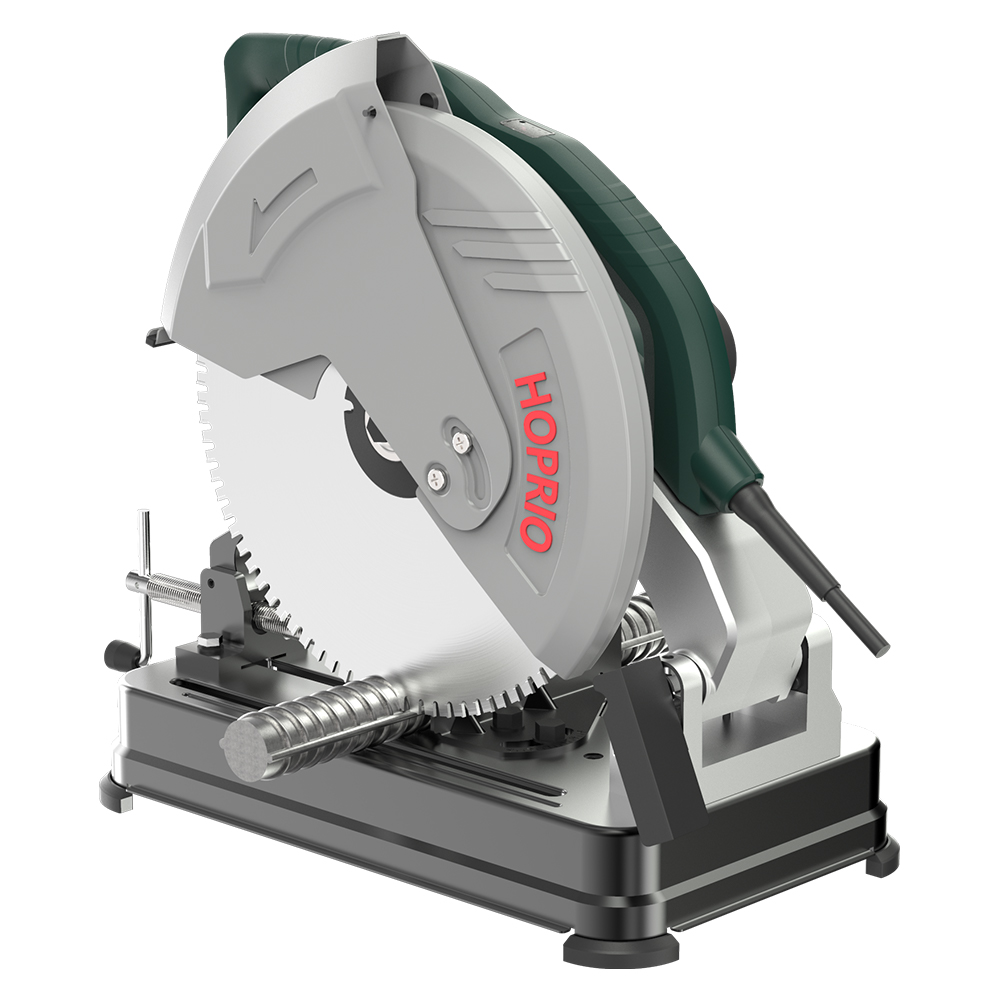
Most blades carry a marked maximum speed. A 14-inch cold saw such as the HOPRIO J1G-355YE3 runs at 1,000 RPM (700–1,000 RPM range); a blade marked 1,600 RPM is suitable, while a blade marked 850 RPM is not.The rule is simple: the blade's marked maximum speed must be equal to or higher than the tool's maximum no-load speed. If the marking is unreadable, discard the blade.
Primary Types of Blades for a Brushless Metal Cutting Saw
Once physical dimensions are verified, the next step involves selecting the cutting medium. The industrial market offers several distinct technologies. Each interacts differently with unique power delivery systems.
Carbide-Tipped Blades
A cold saw blade features a tensioned steel core equipped with individual teeth made from Cermet or Tungsten Carbide. These are the undisputed gold standard for modern brushless tools.
Their defining characteristic is thermal dynamics. Instead of relying on brute-force friction, razor-sharp carbide teeth shear the material. This transfers generated heat directly into metal chips ejected away from the kerf. The milling process leaves the workpiece surprisingly cool to the touch. Cutting efficiently with minimal drag allows the motor to operate within its optimal current draw. This preserves battery life and prevents thermal overload on the control board.
Abrasive Wheels
An abrasive blade is essentially a disposable grinding wheel. It consists of coarse abrasive grains bonded together with a fiberglass mesh and resin.
These wheels are highly effective on older corded drop saws. Yet, they are rarely the best choice for a modern battery-powered tool. Abrasive cutting relies entirely on high-friction grinding. This generates extreme heat, heavy sparking, and significant rotational drag. The resulting drag forces the motor to pull higher amperage. High current draw rapidly depletes battery reserves and triggers internal thermal protection circuits. Furthermore, the physical diameter shrinks as the wheel wears down, constantly reducing your depth of cut.
Diamond Edge Technology
Diamond-edge blades use a steel core with diamond particles bonded to the cutting edge. They are common on masonry and concrete saws, and selected metal-cutting versions exist for abrasive-resistant materials.Their advantage is wear resistance: diamond cuts by abrasion rather than by a sharp tooth, so the edge lasts longer in hard, abrasive materials. The diameter still decreases as the bond matrix wears, just more slowly than an abrasive wheel.Diamond blades do not cut steel as cleanly or as fast as a carbide-tipped cold saw blade, and they are not a substitute for a concrete saw on rebar-reinforced concrete. For steel, stainless and aluminum, carbide or cermet remains the practical choice.
Cold Saw Blades vs. Abrasive Blades: An Objective Comparison
When equipping high-end saws, the decision usually comes down to carbide-tipped cold saws versus traditional abrasives. Analyzing objective performance metrics reveals clear distinctions in everyday usability and commercial value.
| Performance Metric | Carbide-Tipped Cold Saw | Bonded Abrasive Wheel |
| Cut Quality | Burr-free, milled edge ready for welding. | Heavy burrs, requires secondary grinding. |
| Heat Generation | Heat transfers to chips; metal stays cool. | Extreme heat; creates a blue heat-affected zone. |
| Motor Strain | Low drag preserves brushless motor life. | High friction frequently triggers thermal overload. |
| Lifespan | Outlasts 20 to 30 abrasive wheels. | Very short; shrinks continuously during use. |
| Cost Over Time | High upfront cost, but lowest cost-per-cut. | Low upfront cost, but high replacement frequency. |
Selecting the Right Blade Based on the Metal Type
There is no universal solution even within the premium category. The metallurgical properties of your workpiece dictate the necessary tooth geometry, carbide grade, and Tooth Per Inch count required for a safe cut.
Mild Steel and Angle Iron
Standard ferrous metals like low-carbon mild steel and square tubing require a standard metal-cutting carbide blade. These typically feature a moderate tooth count. They are engineered to withstand specific impact forces generated by entering and exiting structural steel. The carbide formulation balances hardness with toughness to prevent shattering upon impact.
Stainless Steel
Stainless steel is notoriously difficult to process. High levels of chromium and nickel make it incredibly tough. It is also highly prone to work-hardening. If a blade rubs against the material without actively cutting, the steel hardens and destroys the teeth instantly.
Cutting stainless requires specialized accessories. These utilize highly specific Cermet tips that are harder and far more heat-resistant than standard tungsten carbide. They also require a higher tooth count to distribute the cutting load. Operators must maintain a steady, aggressive feed rate to prevent heat buildup.
Aluminum and Non-Ferrous Metals
Aluminum, copper, and brass present a completely different mechanical challenge. These soft metals have a low melting point. Cutting them with a standard steel blade causes the soft aluminum to melt and fuse to the carbide teeth. This failure is known as galling. Once gullets clog with aluminum, the blade ceases to cut and begins to violently kick back.
Non-ferrous blades utilize a specific Triple Chip Grind geometry. This effectively breaks soft metal chips into smaller pieces, allowing them to clear the cutting path without clogging.
Thin Sheet Metal vs. Thick Plate
Material thickness dictates the required TPI. A fundamental machining rule states that at least three teeth must be engaged in the material at all times.
Attempting to cut thin HVAC ducting with a low-tooth-count blade causes the metal to slip between the teeth. The blade will snag and tear the material. High TPI is mandatory for thin materials. Conversely, cutting thick steel plate with a high-TPI blade fills the small gullets with heavy chips. The blade will overheat and stall. Thick materials demand low-TPI configurations with deep gullets for proper chip evacuation.
Understanding Tooth Count and Blade Geometry
Packaging uses tooth count, not TPI. TPI (teeth per inch) belongs to band saw blades and hand saws; a circular cold saw blade is specified by its total number of teeth — 36T, 60T, 80T and so on.
Low tooth count
Fewer teeth mean larger gullets. These blades suit thick sections — structural I-beams, solid bar and heavy plate — where the cut produces large chips that must clear quickly. On a 14-inch cold saw, 60T–72T is a common starting point for mild steel.
High tooth count
More teeth produce a smoother cut and are used for thin-wall tube, sheet and stainless, where a low tooth count would catch and tear the material. On a 14-inch saw, 72T–90T is typical for stainless; aluminum usually runs 80T–120T with a triple-chip grind.
Tooth grind styles
The triple-chip grind (TCG) alternates a chamfered trapeze tooth with a flat raker tooth. The trapeze tooth starts the cut and the flat tooth widens it, which distributes load and clears chips — the standard choice for aluminum and other non-ferrous metals.
The alternate top bevel (ATB) grind is intended for wood and wood composites. It is generally too fragile for steel cutting.
Signs It’s Time to Replace Your Metal Cutting Blade
Even the highest quality premium accessories eventually dull. Recognizing wear signs is crucial for maintaining equipment efficiency and ensuring operator safety. Pushing a dull edge forces the brushless motor to overwork.
Visual Inspections
Conduct a brief visual inspection before every shift. Look closely at the carbide tips. Missing teeth, severely chipped corners, or a rounded appearance indicate lost structural integrity. A single missing tooth creates an unbalanced rotation. This leads to micro-vibrations that rapidly destroy remaining teeth.
Performance Feedback
Physical feedback is often the most obvious indicator. A healthy machine should pull itself through the material with minimal operator effort. Bogging down, requiring excessive physical force, or rapid battery drain indicates the edge is no longer cutting efficiently. It is merely rubbing and grinding.
Sensory Warnings
Cold saws are designed to operate with minimal sparking. A sudden heavy shower of sparks indicates the carbide is dull and generating friction. A distinct burning smell, visible smoke, or a high-pitched screeching sound are definitive signs that immediate replacement is necessary.
Pro Tips for Maximizing Blade Life on Your Cutting Machine
Investing in the right accessory is only half the battle. Proper operational technique ensures maximum return on investment.
Let the Tool Do the Work
The most common mistake is forcing the machine through the metal. Excessive downward pressure generates massive heat. Heat is the primary enemy of carbide. Let the RPMs and sharpness dictate the cutting speed. Apply steady pressure and allow the teeth to shave metal away naturally.
Secure the Material
Vibration shatters carbide. If the workpiece is loose or bouncing, teeth will catch at incorrect angles. They will chip or snap off entirely. Always use heavy-duty clamps or a secure vise to lock the material down firmly before initiating a cut.
Proper Plunge and Soft Start Utilization
Never pull the trigger while teeth are resting directly against the metal. This causes immediate violent kickback. Modern premium machines often feature a soft start mechanism. This gradually ramps up the motor to its full 1000 RPM capacity to prevent jarring torque spikes. Always allow the motor to spool up completely before slowly easing into the workpiece.
Corded vs cordless: what changes for blade selection
The fitment rules do not change between corded and cordless brushless saws: diameter, arbor and maximum speed still decide whether a blade is safe. What changes is the consequence of a poor match.
On a cordless saw, a dull or oversized blade draws more current and shortens runtime; the controller may reduce power or shut down before the cut is finished. On a corded saw, the same mismatch shows up as heat, slower cuts and more wear on the motor and controller.
For either platform, choose the smallest blade that completes the cut, keep it sharp, and match the tooth count to the material. Those three choices matter more than the power label on the tool.
Conclusion
Finding the correct accessory is the defining factor between a frustrating, hazardous job and a clean, professional finish. Always match the precise arbor size, respect maximum diameter limits, and verify that RPM ratings align with your equipment's output.
Prioritizing carbide-tipped technology over outdated friction wheels protects your brushless motor from thermal overload. It also guarantees superior, burr-free cuts. Always evaluate the specific metallurgy and thickness of your workpiece to select the perfect TPI and tooth geometry.
Ready to upgrade your fabrication capabilities? Check your equipment's manual for exact specifications and equip your shop with the right tools to truly unlock your cutting potential. For industry-leading performance, explore high-torque, precision-engineered solutions like a cutting machine at Hoprio to find the perfect match for your heavy-duty applications.
Frequently Asked Questions
Can I put a wood-cutting blade on a brushless metal cutting saw?
Absolutely not. Wood blades feature a completely different tooth geometry and aggressive positive rake angles. They are manufactured from carbide grades not built to withstand the extreme impact of steel. Using a wood blade on steel is highly dangerous and will result in immediate kickback and shattered teeth.
Why does my brushless saw stop in the middle of a cut?
Smart tools are equipped with internal control boards that monitor temperature and amperage draw. If you are using a dull blade, pushing too hard, or using an incompatible accessory that causes excessive drag, the motor pulls too much current. The computer triggers a thermal overload protection circuit to prevent a meltdown, shutting the tool down safely.
Can I use an abrasive blade on a saw designed for cold saw blades?
While it might physically fit, it is highly discouraged. Abrasive cutting creates fine, gritty fiberglass dust. While modern motors are generally well-sealed, this highly abrasive dust can still infiltrate the housing. This causes premature wear to internal bearings and moving parts. Stick to carbide to prolong equipment life.
How long do metal cutting blades last?
Lifespan depends entirely on the material being cut and operator technique. A premium carbide-tipped cold saw can easily outlast 20 to 30 standard abrasive wheels when used correctly on mild steel. Applying excessive pressure or failing to secure the workpiece will significantly reduce this lifespan by chipping the brittle carbide teeth.
Can you sharpen a metal cutting cold saw blade?
Yes. Unlike disposable abrasive wheels, high-quality carbide-tipped blades can often be resharpened multiple times. Professional tooling shops can regrind the carbide tips to factory sharpness, provided the steel core is not warped and no teeth are completely snapped off. This significantly lowers the overall cost-per-cut over the long term.


