Introduction
Choosing the right angle grinder disc is essential for achieving efficient cutting, grinding, and surface preparation. However, disc selection involves more than checking the diameter. You also need to consider motor performance, operating speed, material compatibility, and tool specifications.
For professionals using a corded brushless angle grinder, the combination of AC power supply and advanced brushless motor technology provides consistent power for demanding applications. Unlike traditional brushed tools, brushless designs eliminate carbon brush wear and offer improved energy efficiency with reduced maintenance requirements.
Choosing an incompatible angle grinder disc can reduce cutting efficiency, increase vibration, and create serious safety risks. The correct disc size and type help the grinder deliver reliable performance while protecting both the operator and equipment.
This guide explains the differences between common disc diameters, how brushless motor technology affects grinding performance, and what specifications to check before choosing an abrasive accessory.
Key Takeaways
Corded Brushless Performance: AC brushless motors combine mains-powered operation with efficient electronic control and reduced brush-related maintenance.
Common Disc Sizes: 115mm and 125mm discs are widely used for professional cutting, grinding, and surface preparation.
Application Matching: Smaller discs offer better maneuverability, while larger discs provide greater potential cutting depth.
Power Compatibility: Check the grinder's rated voltage, power, maximum speed, and disc specifications before operation.
Safety First: Always match disc diameter, bore size, RPM rating, and protective guard to the grinder.
Why a Corded Brushless Motor Changes How You Choose Discs
Traditional angle grinders commonly use brushed motors. These motors rely on carbon brushes and mechanical contact to transfer electrical current. Over time, the brushes wear down and require replacement.
A corded brushless angle grinder uses electronic control technology instead. Its brushless motor eliminates traditional carbon brushes and supports more efficient power conversion.
This difference affects how professionals evaluate grinding accessories, particularly when working with demanding materials.
Consistent Power Under Heavy Load
Corded brushless grinders draw electricity directly from an AC power supply. This provides continuous access to the available mains power without depending on battery capacity or charging cycles.
An intelligent controller helps regulate motor operation when grinding resistance changes. This supports more consistent speed and power delivery during demanding applications.
For example, when grinding thick steel plates or removing weld seams, the motor must handle changing resistance throughout the operation.
A high-efficiency brushless motor can help maintain stable performance under these conditions. However, operators should still select discs within the grinder's rated specifications.
Importantly, brushless technology does not mean that a grinder can accommodate an oversized disc. The maximum disc diameter must always match the tool's design and protective guard.
Power Supply and Continuous Operation
For corded angle grinders, electrical supply compatibility is an important purchasing consideration.
Unlike cordless equipment, these tools do not depend on battery capacity. Their operating performance is influenced by the electrical supply, motor specifications, and controller design.
Before choosing a grinder, buyers should check several factors:
Rated Voltage: Confirm that the grinder matches the available AC power supply.
Rated Power: Compare the motor's rated input power with the requirements of the intended application.
Operating Current: Ensure that the electrical circuit can support the tool's current requirements.
Extension Cables: Select cables with suitable current ratings and conductor sizes to minimize voltage drop.
Working Conditions: Consider ventilation, operating pressure, and continuous-duty requirements when planning production tasks.
A properly matched corded brushless grinder can provide reliable power for workshop fabrication, construction, and industrial maintenance.
Choosing Larger Disc Sizes for Corded Brushless Grinders
Different angle grinder diameters serve different working requirements.
Corded brushless technology supports efficient power delivery, but the appropriate disc size still depends on the grinder's mechanical design and rated capacity.
A larger disc can increase cutting depth and material coverage. However, it also requires a compatible motor, gearbox, spindle, and protective guard.
Professional buyers should evaluate the complete tool configuration rather than choosing a disc based on diameter alone.
Standard Dimension Classifications Explained
Angle grinder discs are available in several standardized diameters. Each size offers different advantages depending on the material and working environment.
115mm or 4.5-Inch Profiles
The 115mm disc is a common choice for light and medium-duty grinding applications.
Its compact diameter makes it easier to control in restricted spaces. Automotive repair, small fabrication projects, and detailed weld preparation are typical applications.
The smaller disc also allows operators to perform more controlled movements when working around corners and narrow metal sections.
125mm or 5-Inch Profiles
The 125mm disc is widely used in professional metalworking and fabrication environments.
Compared with a 115mm disc, its larger diameter provides greater potential cutting depth and more working surface.
This size offers a practical balance between maneuverability and material removal capability.
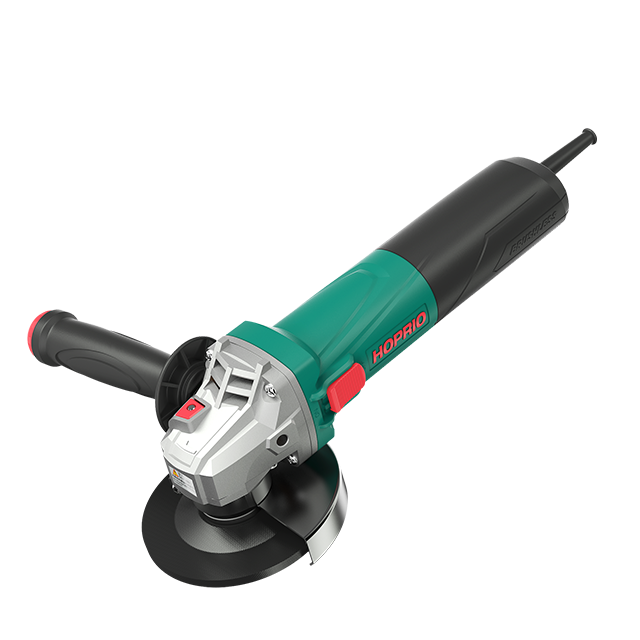
HOPRIO's 5-inch brushless angle grinders are designed for professional cutting, grinding, and polishing applications.
For example, the S1M-125YE1 features a corded brushless motor, 125mm disc diameter, 220–240V rated voltage, and 1250W rated power.
Heavy-Duty 180mm and 230mm Wheels
Larger discs are designed for heavy-duty angle grinders.
The 180mm and 230mm configurations are commonly used for demanding industrial applications, including concrete cutting, structural metalwork, and large pipeline fabrication.
These tools generally require more substantial motor and gearbox assemblies.
They also demand careful handling because of their larger rotating mass and greater cutting capacity.
Operators should always use the disc diameter specified by the grinder manufacturer.
The Big Debate: 115mm vs. 125mm Setup
When selecting an angle grinder for professional applications, the difference between 115mm and 125mm discs deserves careful consideration.
Both sizes offer practical advantages, but their suitability depends on the working environment and material requirements.
| Specification | 115mm System | 125mm System |
| Cutting Depth | Lower potential cutting depth | Greater potential cutting depth |
| Maneuverability | Excellent in restricted spaces | Good for general fabrication |
| Typical Applications | Automotive repair, detailed weld grinding | Pipe cutting, metal fabrication, surface preparation |
| Tool Compatibility | Requires a grinder rated for 115mm discs | Requires a grinder rated for 125mm discs |
| Working Requirements | Suitable for smaller grinding tasks | Suitable for broader cutting and grinding tasks |
Depth of Cut Differences
Disc diameter directly affects the maximum potential cutting depth.
A 125mm disc has a radius that is 5mm larger than a 115mm disc. This creates additional potential cutting reach.
However, actual cutting depth depends on the grinder's gearbox housing, protective guard, spindle position, and disc design.
For this reason, buyers should check the manufacturer's specified cutting depth rather than assuming that the full disc radius is available.
When cutting thick steel tubing or structural sections, the required cutting depth should be evaluated before selecting the grinder.
Tool Maneuverability and Ergonomics
Smaller discs generally provide better control in confined working environments.
A grinder equipped with a 115mm disc is often easier to maneuver around narrow corners, small weld seams, and restricted metal surfaces.
A 125mm setup offers a larger working diameter but may require more space and careful handling during directional changes.
For extended grinding operations, operators should also consider tool weight, handle design, vibration levels, and overall balance.
Matching Your Abrasive to the Material and Project
Choosing the correct diameter is only part of disc selection. The abrasive material and disc design must also match the workpiece.
Different materials create different levels of friction, heat, and resistance. Selecting the right accessory helps improve working efficiency and surface quality.
Metal Fabrication and Welding Preparation
Metal fabrication frequently involves cutting, grinding, weld removal, and surface finishing.
For heavy weld seam removal, a grinding wheel provides aggressive material removal. A flap disc is more suitable for blending welds and preparing surfaces for further processing.
When working inside corners or around narrow joints, smaller accessories may provide better access.
A corded brushless grinder with suitable power and speed control can support consistent grinding performance throughout these operations.
Cutting Concrete, Tile, and Masonry
Concrete, stone, and ceramic materials require suitable diamond cutting blades.
Disc diameter determines the potential cutting depth, while the diamond segment design affects cutting performance and material compatibility.
When selecting a blade, check its maximum operating speed, application rating, and whether it is designed for wet or dry cutting.
Never use a blade outside its specified operating conditions.
Types of Discs for High-Efficiency Brushless Motors
The physical size and specifications of the grinder determine which accessories can be safely installed.
Brushless motor technology improves power efficiency and reduces brush-related maintenance. However, it does not change the fundamental compatibility requirements of abrasive discs.
Abrasive Cutting Wheels
Cutting wheels are designed for slicing through metal and other compatible materials.
Thin cutting discs, including some 1.0mm to 1.6mm options, reduce material removal and can support cleaner cutting operations.
These discs should only be used for cutting. They must not be applied to side grinding unless specifically designed for that purpose.
Always maintain the correct cutting angle and avoid excessive downward pressure.
Grinding Wheels and Flap Discs
Grinding wheels are thicker and designed for more aggressive material removal.
They are commonly used for removing weld seams, leveling metal surfaces, and preparing components for further processing.
Flap discs contain overlapping abrasive layers and are suitable for blending, finishing, and surface conditioning.
The correct abrasive grade and disc diameter depend on the material, desired finish, and grinding pressure.
Wire Brushes and Cup Wheels
Wire brushes and cup wheels are useful for removing rust, paint, scale, and surface contaminants.
Their compatibility depends on brush diameter, mounting design, operating speed, and protective guard clearance.
Before installation, verify that the accessory matches the grinder's spindle and mounting specifications.
Crucial Safety Specifications: RPM, Arbor Size, and Guards
Even a high-performance corded brushless grinder requires compatible accessories and correct operating procedures.
Disc failure at high rotational speeds can cause serious injuries.
Matching RPM Ratings
The maximum safe RPM rating printed on the disc must be equal to or higher than the grinder's maximum no-load speed.
For example, if a grinder operates at a maximum no-load speed of 10,000 RPM, the selected disc must have a compatible rated speed.
Never install an accessory with a lower maximum RPM rating.
The disc manufacturer’s operating instructions should always be followed.
Understanding Arbor Fitment
The arbor is the mounting hole at the center of the disc.
Many standard 115mm and 125mm grinding discs use a 22.23mm bore. However, buyers should verify the exact accessory dimensions before installation.
The spindle thread must also match the grinder's mounting system.
For example, HOPRIO's S1M-125YE1 5-inch angle grinder uses an M14 spindle.
Incorrect mounting can cause excessive vibration, poor disc alignment, and potential accessory failure.
The Golden Rule of Safety Guards
Never remove the factory safety guard to install an oversized disc.
The guard protects operators from sparks, fragments, and potential disc failure.
Every grinder has a maximum approved disc diameter. Using a larger accessory can compromise the protective structure and create serious operating risks.
If a project requires greater cutting depth, select a grinder specifically designed for the required disc size.
How to Optimize Your Grinding Work
Choosing the right disc is only one part of achieving consistent results.
Professional users should also consider speed control, vibration management, and regular equipment inspection.
Variable Speed Integration
Some corded brushless angle grinders feature adjustable speed control.
This allows operators to select suitable operating speeds for different accessories and materials.
For example, polishing applications may require lower speeds, while compatible cutting discs are generally designed for higher operating speeds.
Always follow the accessory manufacturer's speed recommendations.
Do not exceed the maximum rated speed of any disc or brush.
Vibration and Tool Maintenance
Vibration can affect both grinding accuracy and operator comfort.
Using damaged, poorly balanced, or incorrectly mounted discs can increase vibration and place additional stress on the spindle and bearings.
Before each operation, inspect the disc for cracks, chips, deformation, or other visible damage.
For corded equipment, also inspect the power cable, plug, housing, and switch.
Regular inspection and proper accessory installation help maintain reliable performance and extend equipment service life.
Conclusion
Choosing the right angle grinder disc requires balancing cutting depth, maneuverability, material compatibility, and safety.
The 115mm disc is suitable for detailed work and restricted spaces, while the 125mm configuration provides greater cutting reach for general fabrication and professional grinding tasks.
For industrial users, a corded brushless angle grinder offers an effective combination of AC power supply, efficient motor operation, and reduced carbon brush maintenance.
However, the correct disc must always match the grinder's rated diameter, RPM, spindle, and protective guard.
Understanding these specifications helps buyers select suitable accessories and achieve reliable results across different applications.
FAQ
What are the advantages of a corded brushless angle grinder?
A corded brushless angle grinder combines direct AC power with an electronically controlled brushless motor. It eliminates carbon brush replacement and can provide efficient power delivery, reduced maintenance requirements, and reliable performance for professional grinding applications.
Are corded brushless angle grinders suitable for heavy-duty metalworking?
Yes. Suitable models can support demanding metal cutting, weld removal, surface preparation, and industrial grinding. Buyers should evaluate rated power, maximum speed, disc diameter, and operating requirements before selecting a grinder.
What is the difference between 115mm and 125mm angle grinder discs?
A 115mm disc offers better maneuverability in restricted spaces. A 125mm disc provides greater potential cutting depth and is widely used for general metal fabrication and professional grinding.
Can I install a 125mm disc on a 115mm angle grinder?
No. You should never install a disc larger than the maximum diameter specified by the grinder manufacturer. The protective guard and mechanical design must support the selected disc size.
Do corded brushless angle grinders use the same discs as brushed grinders?
Generally, yes. Disc compatibility depends on diameter, bore size, maximum RPM, and application rating rather than whether the motor is brushed or brushless.
What power specifications should buyers check before purchasing a corded angle grinder?
Check rated voltage, frequency, input power, current, and maximum no-load speed. Also verify that the electrical supply and circuit can support the tool's operating requirements.
What disc thickness is suitable for cutting steel?
Some thin cutting wheels are available in thicknesses around 1.0mm to 1.6mm. The appropriate thickness depends on the steel type, cutting conditions, grinder specifications, and accessory manufacturer's recommendations.
About HOPRIO
HOPRIO specializes in AC brushless motor technology, intelligent controllers, and professional power tools. The company develops and manufactures brushless solutions for metalworking, equipment manufacturing, construction, and other industrial applications.
With integrated motor and controller development capabilities, HOPRIO focuses on improving tool efficiency, durability, and operational reliability.
Explore our company profile to learn more about HOPRIO's brushless technology and manufacturing capabilities.
If you are looking for a reliable corded brushless angle grinder for professional applications, contact HOPRIO to discuss product specifications, customization requirements, and cooperation opportunities.


