You start cutting and the tool feels powerful — but twenty minutes in, the grinder slows noticeably, the disc stops biting cleanly, and then the tool shuts off entirely. This isn't a defect. It's the thermal protection doing its job. But if it kicks in that fast, it's telling you something about how well the tool handles heat.
Heat is the leading cause of power tool failure in industrial settings, and in a corded brushless tool it doesn't appear randomly — it builds up in specific components. How well it's managed is what determines whether your tool runs all shift or keeps interrupting production.
Where the Heat Comes From
Inside a corded brushless tool, three things generate heat at the same time. The motor windings are the biggest source — copper wire resists current, and the harder the motor works to hold speed under load, the more heat the windings produce. The controller adds to this by switching power to the motor coils thousands of times per second, each switch releasing a small amount of heat that accumulates quickly at full load. In DC brushless tools, there's a third source: the rectifier and capacitors needed to convert wall power to DC, which generate extra heat inside the controller housing and degrade further as they age.
All of this happens simultaneously inside a compact housing with limited room to shed heat. That's the core challenge.
What Separates Good Thermal Design From Bad
Smart airflow — not just "there's a fan"
Every corded power tool has an internal fan. The difference is where that airflow actually goes. Without proper internal channels, air takes the shortest path and exits without picking up much heat. A well-designed tool uses internal baffles to direct air past the hottest components — the motor windings and the controller. A quick field test: hold your hand near the exhaust vent while the tool is warm. If the exhaust air isn't noticeably hot, the airflow isn't doing its job.
Housing material matters here too. An aluminum motor housing conducts heat roughly four times better than plastic, acting as a passive heat sink during sustained use — a detail that never appears on a spec sheet but is felt clearly after an hour of hard running.
Fewer heat sources to begin with
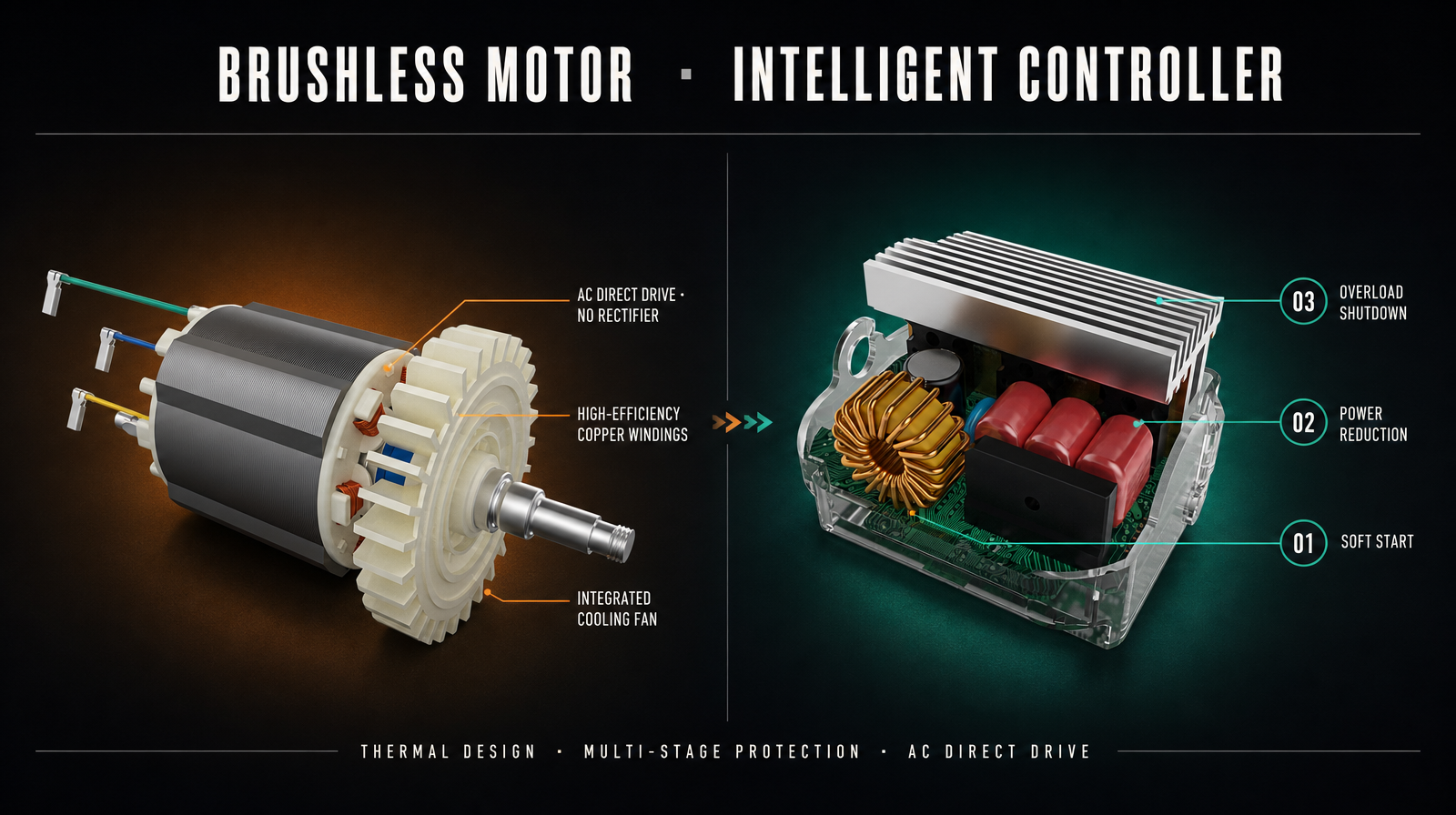
HOPRIO's AC brushless design skips the rectifier and capacitors entirely. The motor runs on AC directly from the wall — no conversion step, no extra heat-generating components inside the controller. The controller runs cooler from day one, and that advantage doesn't erode as components age.
Three-level protection instead of one
Basic protection uses a single temperature threshold: hit the limit, shut off. You stop work, wait 5–10 minutes, start again.
Smart protection adds a middle stage. Before temperatures reach a dangerous level, the controller gradually reduces power — just enough to slow the heat buildup — while the tool keeps running. You might notice a slight drop in cutting speed, but production continues. Only extreme, sustained overloads trigger a full shutdown.
The practical difference is visible in how the tool behaves over a long shift. A tool that shuts off repeatedly has basic single-threshold protection. A tool that maintains consistent speed throughout — only occasionally dialing back slightly has genuinely good thermal management.
What to Look for When Buying
Does the thermal protection gradually reduce power before shutting down, or does it just cut out?
● Gradual reduction keeps you working; abrupt shutdown stops production.
Does the tool use AC brushless or DC brushless?
● AC brushless eliminates the rectifier and capacitor heat sources entirely.
Is the motor housing aluminum or plastic?
● Aluminum dissipates sustained heat far more effectively.
Do the motor and controller come from the same manufacturer?
● Matched systems can tune thermal thresholds together — mismatched combinations approximate.
Conclusion
A tool that slows down or shuts off during sustained use isn't just inconvenient — it's telling you that the thermal design isn't keeping up with the job. The best corded brushless tools handle heat so well that you never have to think about it. The protection system runs in the background, the tool maintains its speed, and you work through the whole shift without interruption.
HOPRIO's corded brushless tools use an AC brushless, capacitor-free design with multi-level thermal protection — including soft start, overload, and over-temperature response — all managed through the in-house designed controller.