Surface preparation is often the most labor-intensive phase of manufacturing, woodworking, and restoration, where tooling inefficiencies directly compound labor hours and compromise finish quality. Operators frequently struggle with traditional sanders that bog down under load, leave directional scratch patterns, or require constant battery management during continuous-use applications. When you run a shop floor or manage a restoration crew, equipment bottlenecks kill productivity. Evaluating the shift from traditional brushed or sheet sanders to a Corded Brushless Random Orbital Sander requires analyzing motor efficiency, motion mechanics, and power delivery to determine if the equipment aligns with operational demands. We need to look at how these tools handle heavy stock removal, fine finishing, and daily abuse on the job site.
Motion Mechanics: Traditional orbital (sheet) sanders use a fixed circular motion prone to leaving directional scratches, whereas random orbital sanders utilize rotational momentum for a swirl-free finish.
Motor Technology: Brushless motors maintain constant RPM under heavy loads and feature a lower center of gravity, significantly reducing operator fatigue compared to traditional brushed motors.
Power Source Reality: For continuous, high-friction tasks, corded models eliminate severe battery drain and ecosystem lock-in, pairing logically with tethered dust extraction systems.
Application Specificity: High-stakes finishing, such as marine gelcoat polishing or fine hardwood prep, demands the sustained torque and variable speed control inherent to brushless systems.
Defining the Baseline: Traditional Sanders vs. Random Orbital Mechanics
Standard Orbital (Sheet) vs. Random Orbital Motion
Understanding the mechanical difference between sanding motions dictates the quality of your final surface. A standard sheet sander moves the pad in a tight, uniform circle, usually about 1/16 to 1/8 inch in diameter. Because the pad does not spin, the abrasive grains drag across the wood fibers in the exact same looping path thousands of times per minute. This repetitive action cuts distinct, overlapping circular grooves into the material. You might not see these grooves on raw wood, but the moment you wipe on a dark stain or spray a clear lacquer, those pigtail scratches pop out and ruin the piece.
A random orbital sander changes the physics of the cut entirely. It combines two distinct movements to prevent patterning. First, the motor drives an eccentric bearing that forces the pad to orbit in a tight circle. Second, the pad assembly sits on a free-spinning bearing, allowing the rotational momentum to spin the pad in a larger circle simultaneously. The abrasive grain never follows the same path twice. The resulting scratch pattern is completely randomized, blending into the surface so tightly that the human eye cannot detect it.
This dual-action mechanism delivers aggressive material removal on wide, flat panels like tabletops or hull sections. However, the round pad creates a hard physical limitation. You cannot push a spinning 5-inch or 6-inch circle into a 90-degree inside corner. The edge of the pad will slam into the adjacent wall, damaging the tool and gouging the workpiece. You always need a secondary detail sander or a manual sanding block to finish inside corners.
Sander Mechanics Comparison
| Feature | Standard Orbital (Sheet) | Random Orbital |
| Pad Shape | Square or Rectangular | Round |
| Motion Type | Fixed circular oscillation | Eccentric oscillation with free-spin |
| Scratch Pattern | Directional, prone to swirl marks | Randomized, swirl-free |
| Corner Access | Excellent (90-degree reach) | Poor (Requires detail companion tool) |
| Material Removal | Slow to moderate | Aggressive to very fast |
The Limitations of Traditional Brushed Motors
Traditional electric motors rely on carbon brushes to transmit electrical current to the spinning commutator on the armature. This is a friction-based power delivery system. The brushes physically rub against the copper commutator plates while the motor spins at 10,000 RPM. This constant physical contact generates massive amounts of heat and causes continuous wear. Over time, the carbon brushes grind down to nothing. If an operator ignores the maintenance schedule and fails to replace the brushes, the metal brush holders will gouge the commutator, destroying the tool entirely.
Beyond maintenance, brushed motors suffer from severe performance drop-off under load. When you press down on a brushed sander to level a stubborn glue joint or strip thick marine varnish, the physical resistance overcomes the motor's torque. You can hear the pitch of the motor drop as the RPM sags. This speed reduction destroys your scratch pattern. The abrasive stops cutting cleanly and starts plowing through the material, leaving deep, irregular gouges. Operators instinctively push harder when the tool slows down, which only generates more heat and glazes the sandpaper.
Brushed motors also dictate a terrible form factor. The armature and brush assembly require a tall, vertical housing. This stacks the weight of the motor high above the sanding pad, raising the center of gravity. When you move the sander across a surface, that high center of gravity acts as a lever, creating rotational torque on your wrist. You have to grip the tool tightly just to keep the pad flat. After four hours of sanding, that constant wrist tension leads to severe forearm fatigue and poor tool control.
The Engineering Behind a Corded Brushless Random Orbital Sander
Why Brushless Motors Matter for Surface Finishing
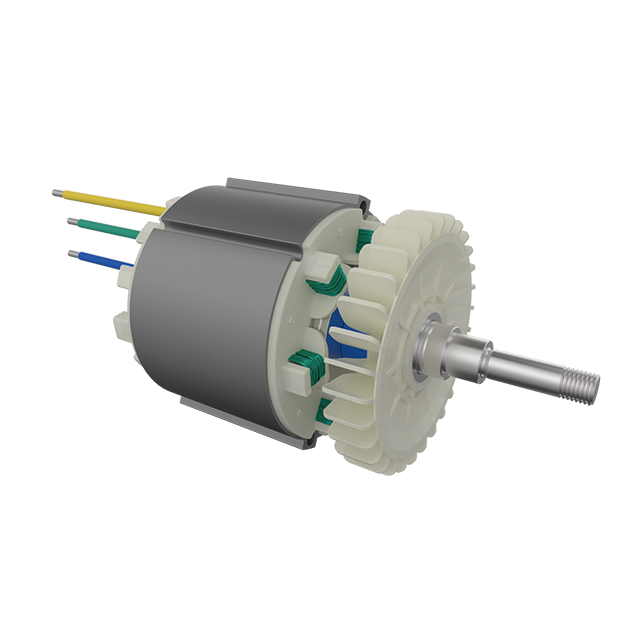
Brushless motors eliminate the physical connection between the power source and the rotor. Instead of carbon brushes, these tools use an electronic commutation process. A micro-controller on the circuit board monitors the exact position of the rotor using Hall-effect sensors. The controller fires electrical pulses to specific copper coils in the stator, creating a rotating magnetic field that drags the rotor along with it.
Because a computer controls the power delivery, the tool can react to physical resistance in milliseconds. When you push down on the sander, the micro-controller detects the increased load and instantly pushes more amperage to the coils to maintain the target RPM. The speed remains absolutely constant, whether you are floating the pad over soft pine or grinding through dense epoxy resin. This constant speed ensures the abrasive cuts at its optimal rate, producing a uniform finish across the entire workpiece.
Removing the bulky brush assembly allows engineers to completely redesign the tool's ergonomics. Brushless sanders feature a squat, low-profile housing. The motor sits directly above the pad, dropping the center of gravity down to the work surface. You can rest your palm directly over the spinning pad, guiding the tool with relaxed fingers rather than a white-knuckle grip. This low profile provides incredible tactile feedback. You can actually feel the surface getting smoother through the tool.
Fewer moving parts also mean tighter manufacturing tolerances and significantly less internal vibration. Hand-arm vibration (HAV) is a major occupational hazard in commercial shops, leading to nerve damage and white finger syndrome. Brushless sanders run incredibly smooth. The internal counterweights balance the eccentric motion perfectly. Operators can run these tools for full eight-hour shifts without experiencing the numbness and tingling associated with older brushed models.
The Case for Corded Power in Continuous Applications
The industry pushes cordless tools heavily, but random orbital sanding exposes the harsh reality of battery limitations. Sanding is a continuous, high-friction, high-draw application. A cordless sander pulling maximum amps will drain a standard 5Ah lithium-ion battery in 15 to 20 minutes. To keep a single operator working continuously, you need at least three high-capacity batteries and a rapid charger cycling constantly. As the battery drains, voltage sag occurs, causing the motor to lose RPM and compromise the finish long before the battery actually dies.
Opting for a corded model breaks the cycle of battery management. You get infinite runtime and unwavering voltage from the first minute to the last. More importantly, a corded tool prevents ecosystem lock-in. You do not have to buy a subpar sander just because it fits the batteries you already own for your drills and saws. You can select the absolute best sanding platform for your specific application.
The mobility argument for cordless sanders falls apart in professional environments because of dust extraction. To achieve a flawless finish and maintain a safe breathing environment, you must tether the sander to a shop vacuum. If you already have a 27mm vacuum hose attached to the back of the tool, adding a power cord introduces zero additional restriction. You simply strap the power cord to the outside of the vacuum hose, creating a single, unified umbilical cord. This two-hose synergy gives you the infinite power of a corded tool with the exact same mobility as a cordless tool attached to a vacuum.
Corded units also maintain perfect weight distribution. Slapping a heavy 8Ah battery on the back of a cordless sander shifts the center of gravity backward. The tool naturally wants to tilt, lifting the front edge of the pad off the wood. The operator has to actively fight this imbalance to keep the pad flat. Corded brushless sanders distribute their weight evenly across the entire pad, doing the work for you.
Technical Evaluation Criteria: Matching Tool to Application
Material Removal Rates and Swirl-Free Finishing
The aggressiveness of a random orbital sander depends heavily on its orbit stroke size. The stroke size dictates how far the pad travels off its center axis during each revolution. Understanding this metric allows you to match the tool to the specific stage of surface preparation.
Stroke Size Application Guide
| Stroke Size | Primary Application | Material Removal Rate |
| 8mm | Heavy stock removal, stripping thick marine coatings | Extremely Aggressive |
| 5mm | General woodworking, leveling joints, paint prep | Moderate to Fast |
| 3mm | Final finishing, veneer sanding, clear coat prep | Fine / Slow |
A 5mm stroke is the industry workhorse. It provides enough aggressive movement to level uneven joints and strip old finishes quickly, but it can still produce a paint-ready surface if you work through the grits properly. A 3mm stroke is a dedicated finishing tool. The tighter orbit leaves a microscopic scratch pattern, making it ideal for the final sanding stages before applying high-gloss clear coats or penetrating oils.
Achieving a swirl-free finish requires a strict abrasive progression. You cannot skip grits. If you start with 80-grit to remove mill marks, you must progress to 120-grit, then 150-grit, and finally 180-grit. Each successive grit exists solely to remove the scratches left by the previous grit. Because a brushless motor maintains constant RPM, the abrasive cuts at a uniform depth. This uniform cut means you spend less time on each grit progression, reaching your final surface state much faster.
Specialized Applications: Marine Gelcoat Polishing and Hardwood Prep
Marine Gelcoat Polishing presents one of the most demanding environments for any rotary tool. Gelcoat is thick, hard, and highly sensitive to heat. When restoring a faded boat hull, operators use heavy cutting compounds to remove oxidation. This process requires sustained torque at very low RPMs. Traditional brushed motors struggle here. When you dial down the speed on a brushed motor, you also reduce its cooling airflow and its torque. Pushing the pad into the hull causes the motor to stall or rapidly overheat, potentially burning the gelcoat. Brushless motors excel in this application. The electronic controller delivers maximum torque even at the lowest speed settings, keeping the pad spinning steadily through thick compound without generating excess heat.
Hardwood preparation demands similar consistency but for different reasons. When sanding a panel glued up from multiple boards of white oak or maple, you encounter wildly varying grain densities. The transition from soft earlywood to dense latewood creates fluctuating resistance against the sanding pad. If the sander's RPM drops when it hits a dense patch, the abrasive stops cutting and starts burnishing the wood. This burnishing seals the wood pores. When you apply a stain later, the burnished areas will not absorb the pigment, leaving ugly, light-colored blotches across the panel. The constant speed of a brushless sander powers through these density changes seamlessly, leaving an evenly porous surface that accepts stain perfectly.
Pad Size Considerations: When to Specify a 125mm Brushless Sander
The standard 150mm (6-inch) sander dominates flat panel work. The larger surface area bridges low spots and flattens wide boards efficiently. However, bigger is not always better. Specifying a 125mm Brushless Sander provides massive operational advantages for specific tasks.
The 125mm (5-inch) platform is the ultimate tool for contoured surfaces. Think about sanding the curved gunwale of a boat, the sculpted armrest of a chair, or the rolled edge of a countertop. A rigid 6-inch pad will bridge across the curve, digging its edges into the material and causing severe gouges. The smaller 5-inch pad navigates these complex topographies easily, conforming to the curve without catching the edges.
Vertical applications also heavily favor the 125mm sander. When you are sanding installed cabinet faces, wall paneling, or the side of a hull, you have to hold the tool up against gravity. The 125mm sander is significantly lighter and more compact. The smaller diameter reduces the gyroscopic effect and the moment arm, meaning the tool exerts far less twisting force on your wrist. This reduction in fatigue allows operators to maintain precise control during long vertical sanding sessions.
Furthermore, the smaller pad concentrates the motor's downward force over a tighter area. When equipped with coarse 60-grit or 80-grit mesh, a 125mm brushless sander becomes an incredibly aggressive stock removal tool, punching well above its weight class while remaining nimble enough to maneuver around hardware and tight inside radii.
Implementation Realities
Operational Efficiency vs. Consumables and Maintenance
Upgrading to brushless technology fundamentally changes shop maintenance schedules. Because there are no carbon brushes to wear out, you eliminate the most common point of failure in electric sanders. You never have to pull a tool off the line, open the housing, and swap out carbon blocks. The internal electronics are fully encapsulated, protecting the circuit boards from the fine, conductive dust generated when sanding carbon fiber or metallic paints. This sealed design keeps the tool running continuously without mandatory maintenance downtime.
Operational efficiency also extends to consumable usage. Sandpaper is expensive, and burning through discs rapidly destroys project margins. Brushless sanders optimize abrasive life through constant speed and superior dust extraction. When a sander bogs down, the abrasive grains drag and tear wood fibers, which quickly clog the grit. By maintaining high RPM, the abrasive slices the fibers cleanly, creating fine dust that the vacuum can easily extract through the pad holes.
Using mesh abrasives amplifies this effect. The vacuum pulls air through the entire surface of the mesh disc, keeping the abrasive grains completely clear of debris. The constant airflow also cools the pad and the work surface. Heat is the enemy of sandpaper; it melts the resins in the wood and the binders in the abrasive, causing the disc to glaze over. Cooler sanding prevents this pitch buildup, allowing a single mesh disc to last three to four times longer than traditional paper discs.
Adoption Risks: Edge Control and Gouging
Despite their benefits, random orbital sanders introduce specific operational risks, particularly regarding edge control. The rotational momentum that provides a swirl-free finish on flat surfaces becomes highly destructive near edges. A common mistake for transitioning operators is trying to sand an inside corner or a narrow edge with a spinning round pad.
When the overhanging edge of a spinning pad catches a perpendicular surface, it bites in aggressively. The tool will violently kick back, instantly gouging the adjacent wall or rounding over a crisp, square edge. You can ruin hours of careful fabrication in a fraction of a second by forcing a random orbital sander where it does not belong. To mitigate this risk, shops must implement strict standard operating procedures for edge work.
Never tilt the sander to address a narrow edge; keep the pad perfectly flat on the primary surface.
Stop the random orbital sander at least one inch away from any 90-degree inside corner.
Mandate the use of oscillating detail sanders equipped with triangle pads for finishing interior corners.
Require manual hand-sanding blocks with rigid backing for breaking sharp edges or sanding delicate profiles.
Train operators to let the weight of the tool do the work; applying heavy downward pressure near an edge will cause the pad to dish out the material.
Conclusion
Audit your current daily sanding hours to determine if battery management is causing measurable downtime on the shop floor.
Inspect your existing dust extraction vacuums to ensure they meet the CFM requirements for tethered tool operation.
Deploy a 125mm brushless model on a complex, contoured workpiece to evaluate its maneuverability against your standard 6-inch tools.
Standardize your abrasive grit sequence across the shop to prevent operators from skipping grits and leaving deep scratch patterns.
Establish strict standard operating procedures that mandate hand-sanding blocks for all delicate edge work and interior corners.
FAQ
Q: Why choose a corded orbital sander over a cordless one?
A: Corded models provide infinite runtime for high-drain continuous sanding and prevent lock-in to a single battery ecosystem. Because optimal sanding requires a vacuum hose for dust extraction anyway, the addition of a power cord does not significantly impact mobility.
Q: What is the difference between an orbital sander and a random orbital sander?
A: Orbital (or sheet) sanders use a square pad and a tight circular motion, which can leave swirl marks. Random orbital sanders utilize rotational momentum—spinning and oscillating simultaneously—creating a randomized pattern that yields a smoother, swirl-free finish.
Q: Are brushless sanders worth the upgrade?
A: Yes, for professional or high-volume users. Brushless sanders maintain constant speed under load, vibrate less, have a lower ergonomic profile, and require zero brush maintenance, leading to higher operational efficiency over time.
Q: Can I use a random orbital sander in corners?
A: No. Due to their round pads and spinning motion, random orbital sanders cannot reach into 90-degree interior corners and will damage adjacent edges if forced. A detail sander or manual sanding block is required for tight edges and corners.
Q: What is a 125mm brushless sander best used for?
A: A 125mm (5-inch) brushless sander offers an ideal balance of control and material removal. It is highly effective for contoured surfaces, vertical sanding, and general woodworking where a larger 6-inch pad might be too cumbersome.
Q: Is a random orbital sander suitable for marine gelcoat polishing?
A: Yes, provided it has a brushless motor capable of maintaining consistent torque at lower speeds. This prevents the pad from bogging down or generating excessive heat that could damage the gelcoat.


